This action intends to call in people accessing beautiful, nature spots in ‘Victoria’ and inform them about the real history of the land they are standing on. By putting up posters in places that are popular for people wanting to access the outdoors in Victoria, the audience will be forced to engage with the history of these places that colonial Victoria has tried to hide and erase. These posters will also be in spots frequented by tourists. As someone who has worked in Victoria’s tourism industry, I have experienced first-hand the ways tourists come to Victoria with an expectation of the “Noble Savage” but tend blissfully ignore the multi-dimensional histories of Lekwungen and WSANEC peoples. These posters intend to inform locals and tourists alike about the realities of the places they consider to be ‘Victoria’s’ iconic landmarks.
Indigenous Feminist Principle
This action relies on the Indigenous feminist principles that strongly connect Indigenous women to the land. Specifically, one principle that is named by Aikau, Arvin, Goeman and Morgensen is that “we must localize the struggle before scaling up the analysis to a regional or global scale” (p.85, 2015) which I believe strongly correlates to the need to be fully aware and connected to the physical land we are doing our work on. If we do not have a full understanding of the ways that this land holds colonial violence, and the ways it was and is so instrumental to Lekwungen and WSANEC peoples, we will never be able to understand the need for Land Back in Canada and transnationally, places like Palestine. The connection and importance of the land is inherently connected to Indigenous feminisms because “[t]his knowledge system, like the women’s mind, is also intricately connected to a relationship with the land” (Doxtator, 1997, p.7). If we can fully understand the ways that Indigenous women are connected to the land than we can understand how violence perpetrated to the land inherently affects Indigenous women.
Action
For our action we created three posters for three iconic places in Victoria: PKOLS (‘Mt Doug’), Meegan (‘Beacon Hill Park’), and Sungyaka (‘Cadboro Bay’) and placed them around these locations. The posters contained information about how these places were used and then how they were violently colonized. This enacts the principle that we must be aware of the harm perpetrated on the lands we currently live and play on before we can begin to look outward.
Ethical or Other Considerations
The first thing that struck me is that nothing was really at stake for me when committing this act. I am a white settler woman who grew up on this territory and have access to many resources. If I were to get caught putting these posters, I am quite confident that the penalties I would face would be nowhere as harsh as if I were an Indigenous woman.
The second thing I took into consideration was the asking myself if it was really my place to be putting up posters informing people about the cultural significance of these places when I am not a part of this culture? I really had to grapple with the idea that I am not entitled to Lekwungen or WSANEC culture and that these cultures are something I feel honoured to learn about when it is shared with me. I think based on this, these posters focus on the ways that these lands were violated and colonized by Europeans to ensure that we are not sharing information that is private. I feel as someone who has essentially lived on these lands my whole life it is my duty to learn about the history of the places, I have frequented for the last 20 years. This is what ultimately led me to the conclusion that sharing the histories of these places would be helpful, not harmful.
Group Relations
I think it was really meaningful to work together in a group for this action because working in solidarity with others can make your voice feel stronger. We all got together to make our posters. I primarily did the research for PKOLS and Meegan. Alanna did all the poster formatting, as well as the support numbers information. Abby and Maddy worked on the information for Sunagyaka as well as the creation of the Indigenous feminist statement that is on all our posters. We all went together to put them up, which felt safer and more special, working together in community.
Images of our Action
Bibliography
Aikau, H., Arvin, M., Goeman, E., & Morgensen, S. (2015). Indigenous Feminisms RoundTable. Frontiers: A Journal of Women’s Studies, 36(3), 84-106. Doxtator, D. (1997). Godi’
Trans definition: “a movement with no clear origin or point of arrival” (p.2)
Preface:
Naming Tamara Dominguez and Blake Brockington, both Black Trans folk who have passed, former of murder and later of suicide.
Naming these two Black trans bodies sets the frame for understanding that these bodies are not supposed to exist and cannot be free within a country built on colonial rule and slavery.
Introduction:
Objective: To examine the transitive connections between blackness and transness.
Method: Bringing together the blackness and transness in the same frame using a range of sources such as afromodernist literature, medical illustrations, and fugitive slave narratives.
Argument: Blackness is intertwined with transness and the separation of these two is a racial narrative.
Part 1: Blacken
Emphasis on ungendered flesh
Anatomically Speaking: Ungendered Flesh and the Science of Sex
Objective: show the ways that flesh became unattached from humanity and gender in the context of medical experiments on enslaved Black women. Also, to recognize the racist history of gynecology.
Method: Examining the medical experiments of Dr. Simms on enslaved Black female bodies, paying close attention to the three named patients: Anarcha, Betsey, and Lucy.
Argument: Black enslaved bodies were ungendered and reduced to flesh all under the guise of medicine.
Trans Capable: Fungibility, Fugitivity, and the Matter of Being
Objective: Explore the connection between the fungibility and fugitivity of Black enslaved bodies.
Method: Using the stories of Mary-Anne Waters, Ellen and William Craft slave narratives using the lens of fungibility.
Argument: The de-gendering of Black flesh opened the space for gender fluidity and a form of ‘trans’ in the context of escaping from enslavement.
Part II. Transit
Reading the “Trans-“ in Transatlantic Literature: On the “Female” within the Three Negro Classics
Objective: Understand the construction of the black maternal figure and its relation to black manhood and the fungibility of black flesh. As well as create an understanding of the production of Black literature.
Method: examines three afromodernist slave autobiographies – that were all eventually published in one collection called Three Negro Classics, while playing close attention to the maternal figurations within these novels.
Argument: black maternal figures reproduce the border between flesh, blackness, and gender in a society structured by anti-blackness.
Part III. Blackout
A Nightmare Silhouette: Racialization and the Long Exposure of Transition
Objective: Understand the racial hierarchy of light to dark bodies and the ways that Black bodies are forced into meaning as the opposition of white bodies.
Method: Examining the representation of Christine Jorgenson, a white trans woman, alongside the representation of black trans figures, Hicks Anderson, Black, the Browns, and McHarris/Grant.
Argument: Narratives of black trans folks act as a countermythologies and provide other ways to conceptualize being trans
DeVine’s Cut: Public Memory and the Politics of Martyrdom
Objective: create time and space for Black life that has ended prematurely without dedicating these lives to martyrdom.
Method: examining the life of Phillip DeVine through the concepts of biomythography and still life.
1. Still life demonstrates how black and trans life continue to accumulate meaning after their death,
2. Biomythography is used here as a way to tell the life story of Phillip DeVine without placing his body into prewritten colonial categories of what that story should be.
Argument: Phillip DeVine had a life, all black people have a life no matter how much that life is deemed out of time or tied to death, and the sharing of these life stories disrupts the narrative that the inevitable fate and value of their body is as a martyr.
Overall thoughts and themes of Black on Both Sides:
Fungibility linked to de-gendering of enslaved Black bodies.
Examining of enslaved narratives, looking directly into their lives to understand their gender presentations.
How are bodies created as free? When is a body free?
Relation between sex, gender, and flesh. Can any exist independently?
You are ten years old now, still secretly sleeping with your stuffed animals, but at the same time starting to wake up and worry about the realities of the world. I know you feel so grown up right now, but also so scared and small in the chaos that surrounds you. You have so many questions right now about what it means to be the perfect feminist. I hate to break it to you, but we are still figuring out what feminism means. We have done so much learning to help us understand some ideas, but at the same time everything seems more blurred and complex than ever.
You know when people ask you what you’re going to name your assumed future kids or how many babies you are going to have, even though you are only ten years old and don’t even think you want to have kids because you like to be in control? Well, these questions and this pressure is because right now you are an able-bodied little white girl who is a people pleaser, athletic, and does well in school. This assumed destiny of your uterus is because right now you are ‘desirable traits’, you are ‘Canadian’ whiteness and your genes are gold. This pressure is not applied to other bodies of colour, of disability, of queerness because as you are subconsciously being taught right now, they are not desirable to our “imperialist white supremacist capitalist patriarchy” run world (hooks, 2012, p.27). This idea of who should have children is called eugenics and is the system in which certain bodies deemed to have ‘desirable traits’ are encouraged to reproduce and bodies that do not ‘fit’ are not and can be prevented from doing so (Wilson).
You recently have learned that being pro-choice is like the answer to feminism and the key to being a good feminist. Perhaps, like many things little Lucy, pro-choice is much more complex than that. Reproductive justice fights have been steeped in reproductive violence (Davis). The pro-choice discourse which implies that you should have kids has also been employed to say that racialized, disabled bodies, should not have kids and utilize eugenicist justification so they cannot. One horrifying example that is still happening today is the forced sterilization of Indigenous women (Rao, 2019). Little Lucy, Indigenous women are being coerced into having procedures that make them unable to have kids, ever. The sterilization of Indigenous women has been justified by eugenicist-based thinking which implies that stopping Indigenous births will solve poverty and will essentially cost the government less money in the long run (Rao, 2019). They are saying that Indigenous bodies are ‘undesirable traits’ by equating their existence to being a money pit and in doing so completely absolve that we live in a country founded on the genocide of these bodies (Rao, 2019). I know it is hard to comprehend that the discourse of pro-choice you cling to so fervently as the golden answer has and continues to cause so much harm.
I hope that you can take this information and change the way you frame your argument. Perhaps we need to shift to thinking that pro-choice does not just mean safe abortion, but also means safe pregnancy and birth for all bodies. Understand that your choice not to have kids is equally as important as the right for all bodies to bring 8lb bundles of ‘joy’ (?) into this world. I leave you with room to think my little love, because I know we need that, it takes a little bit to form what we want to say. I know that you understand that these structures forcing your body to have kids while meanwhile taking this right away from others are painful and linked.
XO, Lucy, ten years older and a lot happier now <3
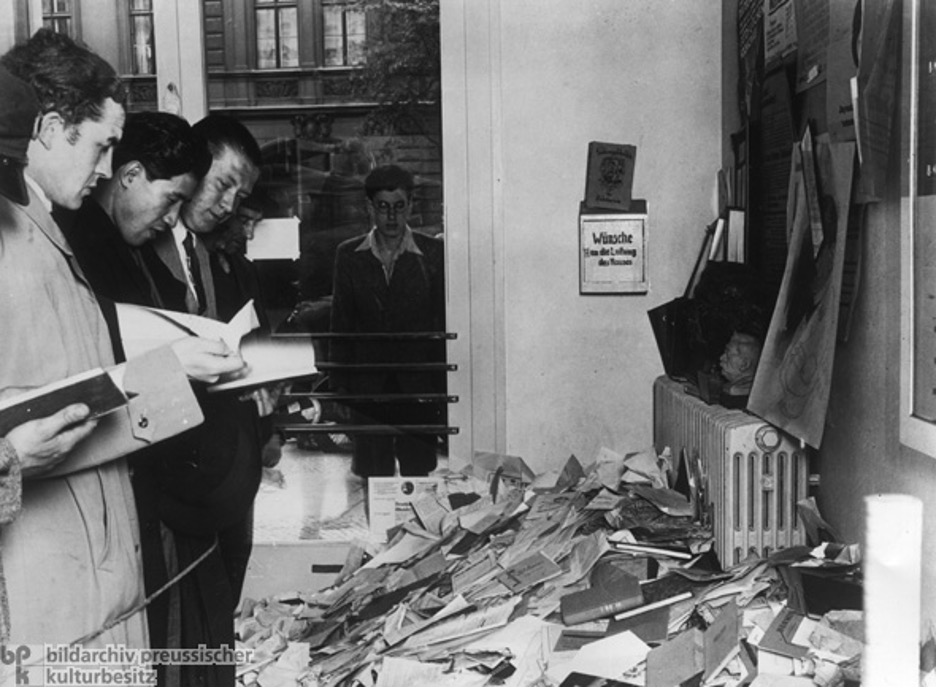
The Weimar period in Berlin created space for the liberation of queer Germans. Liberation may be too strong a description because Paragraph 175 criminalized sex between men and ‘cross dressing’ was still largely penalized.[1]However, a pocket of queer existence and resistance prospered in Berlin at this time and can largely be credited to Magnus Hirschfeld. Hirschfeld, a gay, Jewish sexologist founded the Institute for Sexual Research in Berlin. The Institute provided a space that celebrated and encouraged queer existence. However, the Nazi rise to power in 1933 rejected whatever acceptance had been formed during the Weimar period. One example of this rejection is the raid and burning of materials from the Institute. The image titled: “Institute for Sexual Research in Berlin: “Un-German” and “Unnatural” Literature is Sorted Out for the Book-Burning Ceremony”[2] from the German History of Documents and Images depicts who was involved in the book burning, what was lost, as well as illustrates Nazis’ ideology about queer existence. Despite the portrayal of violence, homophobia, and transphobia, this image forces the remembrance of queer liberation and therefore is a valuable primary source.
This essay employs the use of the term queer to depict trans and homosexual individuals during this period. However, there is an understanding that the term queer would not have been used in this sense at the Institute or in Germany. The decision to use queer is based on the reasoning that not all people at the Institute would fit into the categories of homosexual or transgender. Therefore, the use of queer hopes to leave space for fluidity in these identities.
This image was taken at The Institute for Sexual Research in Berlin. The Institute was founded by Hirschfeld in 1919 with financial support from the government which indicates some acceptance at a political level in Weimar.[3] The Institute “was the first of its kind in the entire world”[4] and had departments of “medicine, biology, psychology, psychiatry, ethnology, research, teaching, lectures, professional training, and sexual policy and reform”.[5] The medical revelations of the Institute included the first ever sex reassignment surgery in 1931 and discoveries about hormone therapy that allowed trans people to match their gender identity to their physical appearance.[6] Many people, including Hirschfeld, called the Institute home which established a vibrant community .[7] The Institute invited the broader public to come and learn about queerness which also fostered community.[8] The community the Institute created demonstrates that it was a space of acceptance, love, and queer joy.[9] Understanding the function of the Institute is critical to conceptualize what the Nazis destroyed.
Examining Magnus Hirschfeld is crucial in understanding the ways he was used to guide and represent Nazi thinking about queer Germans. Hirschfeld was a revolutionary thinker who was well published in areas surrounding sex and gender. He was adamantly opposed to Paragraph 175 and led a campaign arguing for its removal.[10] He worked with the Weimar government to create a transvestite pass so that medically diagnosed “transvestites” could wear clothes that corresponded with their gender without being penalized.[11] Hirschfeld was not trying to convert his patients to the ‘norms’, rather he was finding ways to validate them which opposed Nazi practices of forced conversion.[12] On the radiator in the image, there is a small bust of Hirschfeld. A similar bust was carried by Nazis during the book burning along with chants of “Brenne Hirschfeld” (Burn Hirschfeld)[13] and the bust was supposedly burned in the fire as well.[14] Hirschfeld was a symbolic target for the Nazis because he was gay, a humanist, Jewish, and an advocate for women’s rights; everything the Nazis hated.
It must be stated that the Institute was the target for this book burning because Nazis wanted to erase the existence of queer bodies. Hirschfeld documented the existence of trans bodies in his theory called the third sex which debased Nazi ideology that deemed certain bodies biologically more acceptable than others.[15] Hirschfeld’s scientific research invalidated the debate about the existence of trans bodies, which threatened Nazis’ reliance on binary gender roles. Homosexuality was similarly a target of Nazis because it threatened the birth rate of the Volk. Nazis were targeting queer people and “[h]omosexuality…“transvestites” were listed as two of the organization’s responsibilities”.[16] Furthermore, there were lots of Jewish contributors to the Institute, including Hirschfeld himself, which aided in correlating homosexuality and queerness with deviance.[17] These reasons point to the conclusion that Nazis specifically targeted the Institute as a way to destroy the existence of queer people in Germany.
The book burning itself took place on the 10th of May 1933 “on the Opernplatz in Berlin”[18] and was a public event that drew crowds of upwards of 40,000.[19] The burning was preceded by a parade of Nazi students with the materials.[20] It is critical to examine the raid of the Institute because the “book burning was largely fueled by materials removed from Hirschfeld’s institute”.[21] Material from the Institute sustained the fire of this monumental first book burning, but the recognition that this immense source of queer history was destroyed often gets left out in the retelling.
The people in the image are suspected to be Nazi students because the first book burning on May 10th 1933 was planned by “two national student organizations”.[22] None of the men in the image are wearing uniforms which supports their identity as students. They all appear to be wearing suits and ties which signifies a level of status that Nazi-supporting academics may have had at this time. The identity of these men as students helps to time stamp this image as having been taken in the morning of May 6th 1933 because Nazi students entered the building in the morning, whereas members of the SA joined in the afternoon.[23].
The documents in the image represent what was violently destroyed at this book burning. There are various numbers circulating about how much was stolen from the Institute. The minimum number stated is “10,000 volumes from the IfS… were burned”[24], however other historians place this number at “20,000 volumes, 35,000 photographs, and over 40,000 case studies”.[25] Included in the destroyed materials were manuscripts, “the whole edition of the journal Sexus,” [26], as well as photographs that displayed “individuals whose bodies…challenged the conventional binaries about femaleness and maleness”[27] which Hirschfeld used to simplify his research about gender. These destroyed archives also included case studies by Hirschfeld and other doctors at the Institute.[28] There is speculation that some of these case studies were about Nazis, which has created the theory that the purpose of the raid was to destroy incriminating information.[29] However, the fact that it was students conducting the raid has provided a counterargument because students may not have had the knowledge and time to be searching for Nazi names in the frenzy of the morning raid.[30]
The question of who is missing in this image, demands pursuing because no residents or representatives of the Institute are depicted. As mentioned, the Institute served as home to many, including Dora ‘Dorchen’ Richter, one of the Institutes live in maids.[31] She was the recipient of revolutionary sex reassignment surgeries at the Institute, including a castration, hormone therapy, and most famously, a penectomy and vaginoplasty.[32] Richter was most likely at the Institute during the time of the attack and “there are speculations that she was killed around the time of the raid”.[33] This warrants the question of where Richter when this photo was being taken? Was she being violated during this moment? It is critical to use this photo to consider what Richter’s body was going through on the morning of May 6th 1933, otherwise, she gets forgotten.
On the note, of what is missing from the photo, one must also question whether the photo is staged? There is speculation that photos from this raid were staged to demonstrate that the documents and photos Nazis were destroying were pornographic. There is another photo from this raid that depicts Nazis sorting through documents that feature images of topless women.[34] That photo has been deemed staged because it simultaneously depicts the material as pornographic, while also reaffirming a heterosexual agenda of men being attracted to topless women.[35] There is a chance that that the selected image of “Un-German” and “Unnatural” Literature is Sorted Out for the Book-Burning Ceremony” was staged based on the suspected staging of other images. However, one factor that would invalidate this theory is that none of the documents in the image are legible, therefore there is no way for the audience to decipher if the material they are destroying is problematic. Another issue is that aside from the very small Hirschfeld bust, there is no way for the common viewer to associate this building with the Institute which could lead to misunderstandings that the Nazis were destroying good buildings.
This image portrays the ways in which Nazis targeted queer people in Germany, but it also forces the imagination of what could have been. What could those destroyed documents have been? How could they have shaped understandings of queer people in the 21St Century? What other discoveries could the Institute have made had it not been destroyed? This image forces an analysis of queer people as individuals who had agency and academic power to dictate their own lives as valid. This image is valuable for scholarship about Nazi Germany because it proves the existence of queer power.
[1] Elena Mancini, Magnus Hirschfeld and the Quest for Sexual Freedom,(New York:Palgrave Macmillan, 2010), 92.
[2] “Institute for Sexual Research in Berlin: “Un-German” and “Unnatural” Literature is Sorted Out for the Book-Burning Ceremony”
[3] Mancini, Magnus Hirschfeld and the Quest for Sexual Freedom, 92.
[7] Heike Bauer, “From Fragile Solidarities to Burnt Sexual Objects: At the Institute of Sexual Science”, In The Hirschfeld Archives Violence, Death, and Modern Queer Culture, 78-101 (Temple University Press, 2017), 81.
[8]Mancini, Magnus Hirschfeld and the Quest for Sexual Freedom, 118.
[9] Heike, “From Fragile Solidarities to Burn Sexual Objects”, 82.
[10] Mancini, Magnus Hirschfeld and the Quest for Sexual Freedom 14.
[11]Zavier Nunn, “Trans Liminality and the Nazi State”, Past & Present 260, no. 1 (2022): 123–57.
[12] Mancini, Magnus Hirschfeld and the Quest for Sexual Freedom, 81.
[13] Heike, “From Fragile Solidarities to Burn Sexual Objects”, 93.
[14] Matthew Fishburn, “The Burning of the Books”, In Burning Books, 31-48 (London: Palgrave Macmillian, 2008), 41.
[15] Mancini, Magnus Hirschfeld and the Quest for Sexual Freedom, 50.
[16] Fuller & Owens, “Nazi Gender Ideology, Memorcide, and the Attack on the Berlin Institute for Sexual Research”.
[17] Heike, “From Fragile Solidarities to Burn Sexual Objects”, 92.
[23] Heike, “From Fragile Solidarities to Burn Sexual Objects”, 92.
[24] Matt Fuller & Leah Owens, “Nazi Gender Ideology, Memorcide, and the Attack on the Berlin Institute for Sexual Research,” Peace Review 34, no. 34 (7 Oct 2022): 529-540.
[25] Mancini, Magnus Hirschfeld and the Quest for Sexual Freedom, 140.
[26] Heike, “From Fragile Solidarities to Burn Sexual Objects”, 93.