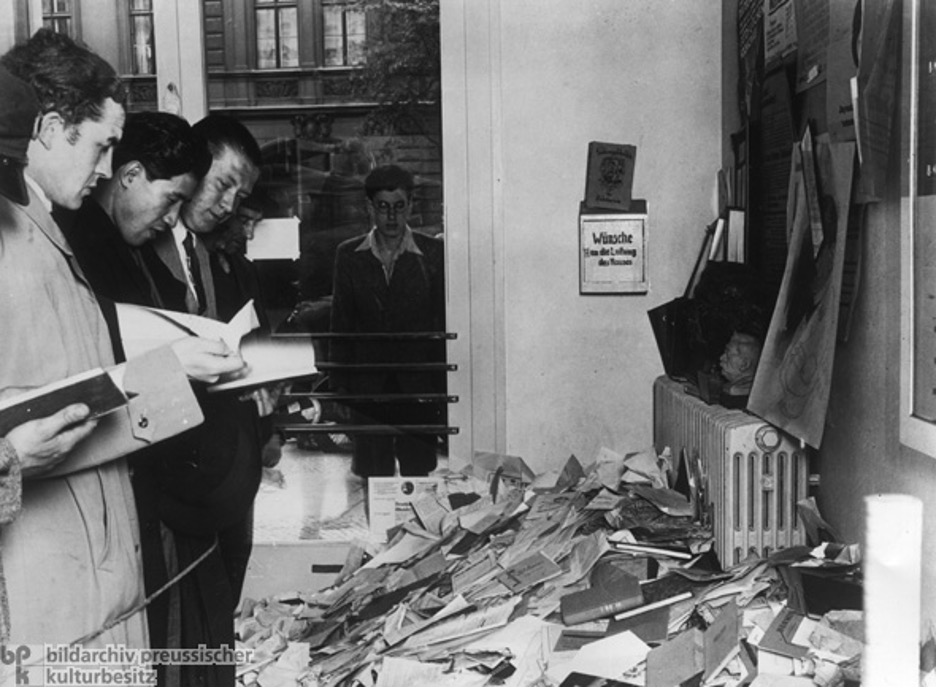
The Weimar period in Berlin created space for the liberation of queer Germans. Liberation may be too strong a description because Paragraph 175 criminalized sex between men and ‘cross dressing’ was still largely penalized.[1]However, a pocket of queer existence and resistance prospered in Berlin at this time and can largely be credited to Magnus Hirschfeld. Hirschfeld, a gay, Jewish sexologist founded the Institute for Sexual Research in Berlin. The Institute provided a space that celebrated and encouraged queer existence. However, the Nazi rise to power in 1933 rejected whatever acceptance had been formed during the Weimar period. One example of this rejection is the raid and burning of materials from the Institute. The image titled: “Institute for Sexual Research in Berlin: “Un-German” and “Unnatural” Literature is Sorted Out for the Book-Burning Ceremony”[2] from the German History of Documents and Images depicts who was involved in the book burning, what was lost, as well as illustrates Nazis’ ideology about queer existence. Despite the portrayal of violence, homophobia, and transphobia, this image forces the remembrance of queer liberation and therefore is a valuable primary source.
This essay employs the use of the term queer to depict trans and homosexual individuals during this period. However, there is an understanding that the term queer would not have been used in this sense at the Institute or in Germany. The decision to use queer is based on the reasoning that not all people at the Institute would fit into the categories of homosexual or transgender. Therefore, the use of queer hopes to leave space for fluidity in these identities.
This image was taken at The Institute for Sexual Research in Berlin. The Institute was founded by Hirschfeld in 1919 with financial support from the government which indicates some acceptance at a political level in Weimar.[3] The Institute “was the first of its kind in the entire world”[4] and had departments of “medicine, biology, psychology, psychiatry, ethnology, research, teaching, lectures, professional training, and sexual policy and reform”.[5] The medical revelations of the Institute included the first ever sex reassignment surgery in 1931 and discoveries about hormone therapy that allowed trans people to match their gender identity to their physical appearance.[6] Many people, including Hirschfeld, called the Institute home which established a vibrant community .[7] The Institute invited the broader public to come and learn about queerness which also fostered community.[8] The community the Institute created demonstrates that it was a space of acceptance, love, and queer joy.[9] Understanding the function of the Institute is critical to conceptualize what the Nazis destroyed.
Examining Magnus Hirschfeld is crucial in understanding the ways he was used to guide and represent Nazi thinking about queer Germans. Hirschfeld was a revolutionary thinker who was well published in areas surrounding sex and gender. He was adamantly opposed to Paragraph 175 and led a campaign arguing for its removal.[10] He worked with the Weimar government to create a transvestite pass so that medically diagnosed “transvestites” could wear clothes that corresponded with their gender without being penalized.[11] Hirschfeld was not trying to convert his patients to the ‘norms’, rather he was finding ways to validate them which opposed Nazi practices of forced conversion.[12] On the radiator in the image, there is a small bust of Hirschfeld. A similar bust was carried by Nazis during the book burning along with chants of “Brenne Hirschfeld” (Burn Hirschfeld)[13] and the bust was supposedly burned in the fire as well.[14] Hirschfeld was a symbolic target for the Nazis because he was gay, a humanist, Jewish, and an advocate for women’s rights; everything the Nazis hated.
It must be stated that the Institute was the target for this book burning because Nazis wanted to erase the existence of queer bodies. Hirschfeld documented the existence of trans bodies in his theory called the third sex which debased Nazi ideology that deemed certain bodies biologically more acceptable than others.[15] Hirschfeld’s scientific research invalidated the debate about the existence of trans bodies, which threatened Nazis’ reliance on binary gender roles. Homosexuality was similarly a target of Nazis because it threatened the birth rate of the Volk. Nazis were targeting queer people and “[h]omosexuality…“transvestites” were listed as two of the organization’s responsibilities”.[16] Furthermore, there were lots of Jewish contributors to the Institute, including Hirschfeld himself, which aided in correlating homosexuality and queerness with deviance.[17] These reasons point to the conclusion that Nazis specifically targeted the Institute as a way to destroy the existence of queer people in Germany.
The book burning itself took place on the 10th of May 1933 “on the Opernplatz in Berlin”[18] and was a public event that drew crowds of upwards of 40,000.[19] The burning was preceded by a parade of Nazi students with the materials.[20] It is critical to examine the raid of the Institute because the “book burning was largely fueled by materials removed from Hirschfeld’s institute”.[21] Material from the Institute sustained the fire of this monumental first book burning, but the recognition that this immense source of queer history was destroyed often gets left out in the retelling.
The people in the image are suspected to be Nazi students because the first book burning on May 10th 1933 was planned by “two national student organizations”.[22] None of the men in the image are wearing uniforms which supports their identity as students. They all appear to be wearing suits and ties which signifies a level of status that Nazi-supporting academics may have had at this time. The identity of these men as students helps to time stamp this image as having been taken in the morning of May 6th 1933 because Nazi students entered the building in the morning, whereas members of the SA joined in the afternoon.[23].
The documents in the image represent what was violently destroyed at this book burning. There are various numbers circulating about how much was stolen from the Institute. The minimum number stated is “10,000 volumes from the IfS… were burned”[24], however other historians place this number at “20,000 volumes, 35,000 photographs, and over 40,000 case studies”.[25] Included in the destroyed materials were manuscripts, “the whole edition of the journal Sexus,” [26], as well as photographs that displayed “individuals whose bodies…challenged the conventional binaries about femaleness and maleness”[27] which Hirschfeld used to simplify his research about gender. These destroyed archives also included case studies by Hirschfeld and other doctors at the Institute.[28] There is speculation that some of these case studies were about Nazis, which has created the theory that the purpose of the raid was to destroy incriminating information.[29] However, the fact that it was students conducting the raid has provided a counterargument because students may not have had the knowledge and time to be searching for Nazi names in the frenzy of the morning raid.[30]
The question of who is missing in this image, demands pursuing because no residents or representatives of the Institute are depicted. As mentioned, the Institute served as home to many, including Dora ‘Dorchen’ Richter, one of the Institutes live in maids.[31] She was the recipient of revolutionary sex reassignment surgeries at the Institute, including a castration, hormone therapy, and most famously, a penectomy and vaginoplasty.[32] Richter was most likely at the Institute during the time of the attack and “there are speculations that she was killed around the time of the raid”.[33] This warrants the question of where Richter when this photo was being taken? Was she being violated during this moment? It is critical to use this photo to consider what Richter’s body was going through on the morning of May 6th 1933, otherwise, she gets forgotten.
On the note, of what is missing from the photo, one must also question whether the photo is staged? There is speculation that photos from this raid were staged to demonstrate that the documents and photos Nazis were destroying were pornographic. There is another photo from this raid that depicts Nazis sorting through documents that feature images of topless women.[34] That photo has been deemed staged because it simultaneously depicts the material as pornographic, while also reaffirming a heterosexual agenda of men being attracted to topless women.[35] There is a chance that that the selected image of “Un-German” and “Unnatural” Literature is Sorted Out for the Book-Burning Ceremony” was staged based on the suspected staging of other images. However, one factor that would invalidate this theory is that none of the documents in the image are legible, therefore there is no way for the audience to decipher if the material they are destroying is problematic. Another issue is that aside from the very small Hirschfeld bust, there is no way for the common viewer to associate this building with the Institute which could lead to misunderstandings that the Nazis were destroying good buildings.
This image portrays the ways in which Nazis targeted queer people in Germany, but it also forces the imagination of what could have been. What could those destroyed documents have been? How could they have shaped understandings of queer people in the 21St Century? What other discoveries could the Institute have made had it not been destroyed? This image forces an analysis of queer people as individuals who had agency and academic power to dictate their own lives as valid. This image is valuable for scholarship about Nazi Germany because it proves the existence of queer power.
[1] Elena Mancini, Magnus Hirschfeld and the Quest for Sexual Freedom,(New York:Palgrave Macmillan, 2010), 92.
[2] “Institute for Sexual Research in Berlin: “Un-German” and “Unnatural” Literature is Sorted Out for the Book-Burning Ceremony”
[3] Mancini, Magnus Hirschfeld and the Quest for Sexual Freedom, 92.
[4] Mancini, 115.
[5] Mancini, 83.
[6] Mancini, 69.
[7] Heike Bauer, “From Fragile Solidarities to Burnt Sexual Objects: At the Institute of Sexual Science”, In The Hirschfeld Archives Violence, Death, and Modern Queer Culture, 78-101 (Temple University Press, 2017), 81.
[8]Mancini, Magnus Hirschfeld and the Quest for Sexual Freedom, 118.
[9] Heike, “From Fragile Solidarities to Burn Sexual Objects”, 82.
[10] Mancini, Magnus Hirschfeld and the Quest for Sexual Freedom 14.
[11]Zavier Nunn, “Trans Liminality and the Nazi State”, Past & Present 260, no. 1 (2022): 123–57.
[12] Mancini, Magnus Hirschfeld and the Quest for Sexual Freedom, 81.
[13] Heike, “From Fragile Solidarities to Burn Sexual Objects”, 93.
[14] Matthew Fishburn, “The Burning of the Books”, In Burning Books, 31-48 (London: Palgrave Macmillian, 2008), 41.
[15] Mancini, Magnus Hirschfeld and the Quest for Sexual Freedom, 50.
[16] Fuller & Owens, “Nazi Gender Ideology, Memorcide, and the Attack on the Berlin Institute for Sexual Research”.
[17] Heike, “From Fragile Solidarities to Burn Sexual Objects”, 92.
[18] Fishburn, “The Burning of the Books, 31.
[19] Fishburn, 34.
[20] Ibid
[21] Heike, “From Fragile Solidarities to Burn Sexual Objects”, 97.
[22] Fishburn, “The Burning of the Books”, 32.
[23] Heike, “From Fragile Solidarities to Burn Sexual Objects”, 92.
[24] Matt Fuller & Leah Owens, “Nazi Gender Ideology, Memorcide, and the Attack on the Berlin Institute for Sexual Research,” Peace Review 34, no. 34 (7 Oct 2022): 529-540.
[25] Mancini, Magnus Hirschfeld and the Quest for Sexual Freedom, 140.
[26] Heike, “From Fragile Solidarities to Burn Sexual Objects”, 93.
[27] Heike, 88.
[28] Mancini, Magnus Hirschfeld and the Quest for Sexual Freedom, 140.
[29] Fishburn, “The Burning of the Books, 42.
[30] Ibid.
[31] Heike, “From Fragile Solidarities to Burn Sexual Objects”, 87.
[32] Fuller & Owens, “Nazi Gender Ideology, Memorcide, and the Attack on the Berlin Institute for Sexual Research”.
[33] Heike, “From Fragile Solidarities to Burn Sexual Objects”, 87.
[34] Heike, 95.
[35] Ibid.